


DBA for Engineers
Page last updated on 12/11/2026
Technology and Business Transformation in the era of AI (TBT-AI)
A DBA designed by engineers for engineers, preparing technology leaders able to transform organizations through innovation, artificial intelligence, sustainability and strategic vision
The DBA Technology and Industrial Transformation aims to prepare experienced engineers, technical managers and executives to become strategic leaders capable of leading the complex projects of business transformation. At a time when AI has, in just a few years, established itself as a global driver of transformation affecting every aspect of the business and interacting with all of its technologies, this program develops a new type of manager,
This programme develops a new profile of technology-oriented manager, combining:
- Deep understanding of emerging technologies
- Strategic management capabilities
- Innovation leadership
- Sustainability and resilience thinking
- Ethical decision-making
- Research-based practice
Through the integration of management sciences, engineering sciences and applied research, participants will learn how to lead organizations facing technological disruption, geopolitical uncertainty, sustainability challenges and the emergence of Artificial Intelligence.
“Our objective is to develop a new generation of managers having a strong background in technology who, through research and interdisciplinary knowledge, are able to master emerging technologies and address current and future management challenges in an ethical, responsible and sustainable manner.”
Programme Structure
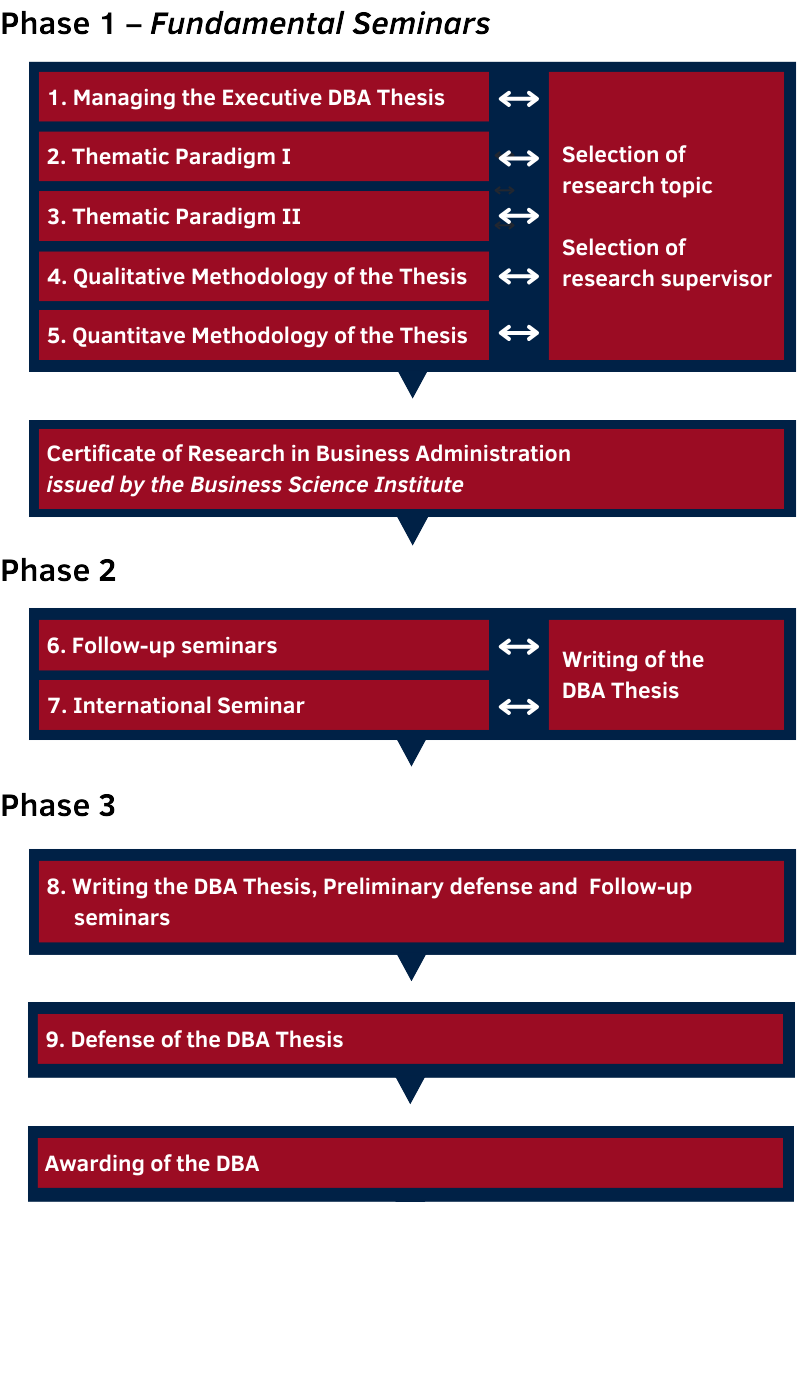
The TBT-IA Executive DBA program is organized into three distinct phases, just like all DBA programs at the Business Science Institute.The TBT-IA Executive DBA program is organized into three distinct phases, just like all DBA programs at the Business Science Institute.
Phase 1 – Foundational Seminars (typically in the first year)
- Conducting the Executive DBA Dissertation
- Thematic Paradigm I
- Thematic Paradigm II
- Qualitative Methodology in the Dissertation Process
- Quantitative Methodology in the Dissertation Process
- Concurrently with Phase 1, the Manager-Doctoral Candidate refines and selects his research topic
- He/she chooses his thesis advisor. Together, they define a timeline and objectives.
Phase 1 concludes with the writing and defense of a document leading to an intermediate degree: the Certificate of Research in Business Administration (CRBA) issued by the Business Science Institute.
Phase 2 (generally spanning the following years)
- Progress seminars (2 to 4 per year). Writing the DBA dissertation
- Impact seminar (in March of the year)
- International seminar (late September of the year) Writing the DBA dissertation
Phase 3 (third or fourth year)
- Writing the DBA dissertation, pre-defense, and follow-up seminars
- DBA dissertation defense
DBA dissertation defense, leading to a degree awarded by the Business Science Institute.
In summary, this training program is organized in an “Executive” format
- 5 intensive modules (2 specialized)
- 3 days per module
- Executive DBA level for engineers with +5 years of experience
- Research-oriented approach
- International perspective
- Strong technological focus (ie AI)
Thematic Paradigm I (Module 2) – From Technology and Engineering to Business or Industrial Strategy
The content and speakers may vary depending on the composition of the cohort.
Examples of topics that can be covered in a half-day or full-day session.
From the Factory of the Future to a Smart Strategy
Topics: Industry 4.0 and Industry 5.0, Artificial Intelligence in organizations, Strategic implications of technological transformation, Building competitive advantage through technology, Smart strategies
Learning outcomes: Participants will understand how technological disruptions reshape value chains and how to translate technological opportunities into strategic decisions.
The New Geopolitical Context and Competitiveness
Topics: Geopolitical risks and enterprises ecosystems, Strategic dependencies, Energy transitions, Supply chain resilience, Technological sovereignty, Global competition in a new geopolitical era
Learning outcomes: Participants will develop the ability to assess geopolitical impacts on company strategy and anticipate future disruptions.
Ethics and Responsible Leadership in Technology Management
Topics: Ethical decision-making frameworks, Responsible innovation, AI ethics and management, Corporate responsibility
Learning outcomes:
Participants will acquire tools to make responsible decisions when facing complex technological and managerial challenges.
Module conclusion, possibly in the form of a “Master Class” (to be confirmed) — Testimony from a technology leader in the digital services industry
- The goal of the conclusion will be to internalize the various testimonials and apply them to one’s daily work. A technical manager may share his or her perspective on technological leadership. He or she will explain the shift in mindset from technical authority (e.g., the ability to fix all bugs, design the best architectures, etc.) to the ability to provide teams with a clear vision of the direction to take and to translate business objectives into stimulating technical challenges.
Thematic Paradigm II. Module 3 – Artificial Intelligence, Sustainability and Innovation Management
From Engineering Expertise to Innovation Leadership
Topics: Innovation processes, Technology transfer, Strategic innovation management, Entrepreneurship and intrapreneurship, Managing multidisciplinary and multicultural teams, Research-to-market pathways
Learning outcomes: Participants will learn how to transform technical expertise into value creation through innovation.
Sustainability, Robustness and Resilience for Future Organizations
Topics: Climate change and industrial transformation, Low-tech innovation, Circular economy, Sustainable business models, Resilient organizations
Learning outcomes: Participants will be able to design resilient organizations capable of adapting to environmental, societal and economic disruptions.
Artificial Intelligence for Business Transformation
Topics: Generative AI, Data-driven decision-making, AI strategy, AI governance, AI-enabled business models, AI for innovation and competitiveness
Learning outcomes: Participants will understand how AI can become a key driver of organizational transformation and strategic advantage.
Module conclusion, possibly in the form of a “Master Class” (to be confirmed) — Testimony from a technology leader in the manufacturing industry (e.g., plant manager).
- The goal of the conclusion will be to internalize the various testimonials and apply them to one’s daily work. Technological leadership in the manufacturing industry is undergoing a profound transformation, characterized by the strategic return of technology-focused professionals to the heart of industrial decision-making. This shift, which combines operational rigor with digital agility, is propelling the industrial digital market toward sustained and significant growth. Technical managers will share their vision of technological leadership and the challenges associated with this new type of role.
Program coordination
- Pr Emmanuel Caillaud – CNAM
- Pr Pierre-Jean Benghozi, Polytechnique School – CNRS – Business Science Institute
Professors for DBA Engineers

LAVASTRE Olivier
Grenoble IAE

GODÉ Cécile
Business Science Institute

FAVIER Marc
Université de Grenoble

CHEVALIER Françoise
HEC Paris

CAILLAUD Emmanuel
Université de Strasbourg


BENGHOZI Pierre-Jean
Business Science Institute

BAUDET Cédric
Haute école de gestion Arc
Differentiating Factors
Unlike traditional DBA programs, which are primarily focused on management, this program is designed specifically for engineers and technology leaders.
- An Engineering-Centered DBA
- A Strong Link Between Technology and Strategy
- Integration of AI, Sustainability, and Geopolitics
- Research-Based Executive Education
- Emphasis on Business Transformation
- Responsible and Ethical Leadership
- International Perspective
Target Audience
- Senior engineers
- Technical directors
- R&D managers
- Innovation managers
- Senior industry executives
- Technology entrepreneurs
- Business transformation consultants
- Engineers seeking to become top managers
- Consultants seeking to address industrial challenges, e.g., related to digital technology and robotics,
Format & Course Structure
This program is taught in English. A similar program is offered in French.
According the origin of participants, the first seminar, “Conducting the Executive DBA Thesis,” will be held in person and online (recorded) (cf. upcoming schedule). The following core seminars will be held on line, approximately every two months.
Program coordinators provide support to participants.
Contact Information for Registration and Additional Information:
- By email: contact@business-science-institute.com
- By phone: +352 621 376 588 (9 a.m.–6 p.m.)