
DBA Graduate Survey 2023 & 2024
Page last updated on 27/01/2026
The Doctorate of Business Administration from Business Science Institute: Training Leaders Capable of Transforming Their Organizations
The DBA is a game-changer: it strengthens leaders’ legitimacy, expands their scope of action, and enables them to directly influence their company’s strategy.
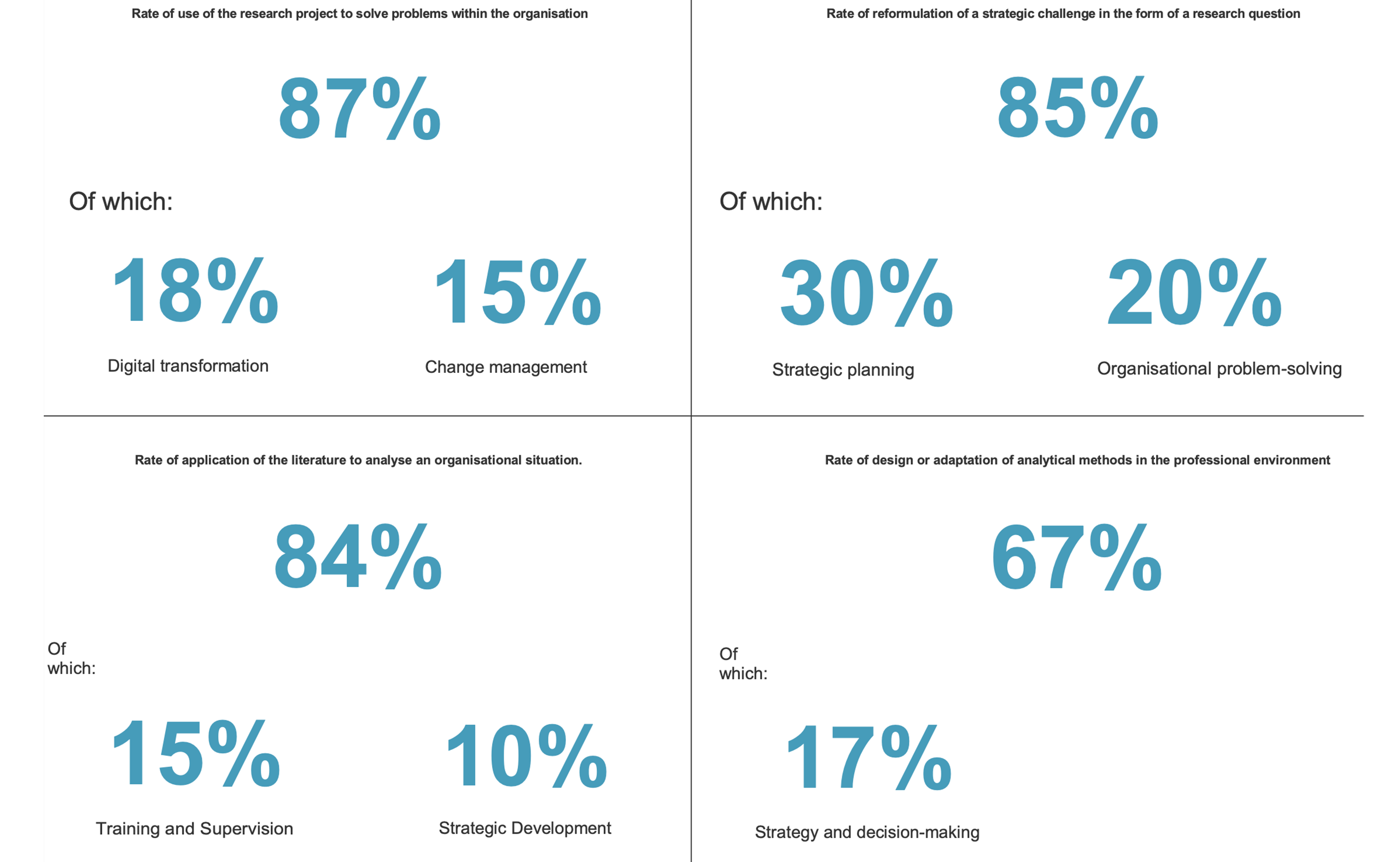
87% of graduates use their research to solve business problems, and 70% disseminate their findings to professional audiences. The DBA has a direct impact on organizational transformation.
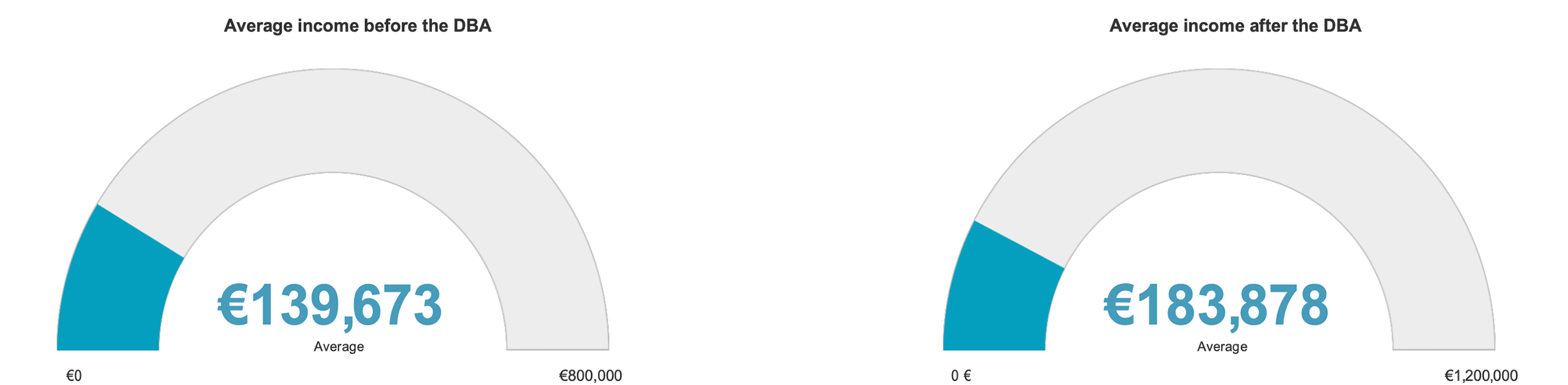
The career impact is equally clear: an average income increase of +40%.
The survey results demonstrate the concrete impact of the DBA. Beyond the numbers, it transforms how leaders practice their roles by reinforcing their position as experts and drivers of transformation.
In an environment where organizations face profound, rapid, and uncertain transformations (ecological transition, digital revolution, the rise of AI, geopolitical tensions), the survival of business models depends on their ability to reinvent themselves. According to PwC[1], 42% of global executives believe their company will no longer be viable in ten years without major changes. The Business Science Institute DBA prepares experienced leaders to meet these challenges through four key competencies:
- Developing a research framework to formulate relevant strategic questions and robust action frameworks in a context of systemic transformation.
- Leveraging and interpreting data to produce reliable, contextualized diagnoses that support strategic decision-making.
- Supporting organizational transformation through high-impact managerial and societal recommendations.
- Disseminating results to professional and academic audiences to facilitate their adoption and implementation.
[1] PWC 28th Annual Global CEO Survey : https://www.pwc.com/gx/en/issues/c-suite-insights/ceo-survey.html
Methodology
Survey Objective: To measure the impact of the Business Science Institute DBA on graduates and their organizations by comparing situations before and after the program and documenting how acquired skills are applied in business settings.
Survey Population
- Cohorts covered: 2023 and 2024
- Respondents: 62 graduates (27 in 2023, 35 in 2024)
- An international survey: 62 graduates from 25 countries across 5 continents. This geographic diversity (Europe: 22, Africa: 21, Asia: 12, Oceania: 4, Americas: 3) reflects the global reach of the program and the intercultural richness of participants’ backgrounds.
- Established leaders with an average of 18 years of experience before the DBA
- Data collection: anonymous online questionnaire
Methodological Framework
- Before/after comparison: compensation, status, responsibilities.
- Structured qualitative component: 18 questions covering all 4 competency areas developed through the DBA:
- Developing a research framework
- Leveraging and interpreting data for decision-making
- Recommendations and support for transformation
- Disseminating results to professional and academic audiences
Key Questions (selection of 6 for communication purposes)
- i. “To what extent has the DBA impacted your compensation and career path?”
- ii. “Have you used your research project to solve a strategic, organizational, or managerial problem in your company?”
- iii. “In your current role, have you reformulated a strategic issue rigorously, as you would a research question?”
- iv. “Have you drawn on academic or professional literature to frame a project or analyze a situation in your company?”
- v. “Have you designed or adapted an analytical method in your professional environment?”
- vi. “Have you supported the implementation of a transformation or change project?”
A dual perspective: figures and testimonials
The survey combines quantitative data (changes in income, status, responsibilities) with qualitative testimonials (graduate verbatims). It provides a robust overview of the DBA’s added value, both for individuals and for the transformation of their organizations.
Results and Impacts
- Developing a Research Framework to Analyze Complex Issues
- 85% of graduates have reformulated a strategic issue as a research question.
- 84% have drawn on academic or professional literature to analyze a business situation.
“The ability to formulate a problem, frame a study, develop hypotheses, and build an offering from a conceptual foundation. I use this in creating innovative services (strategic briefs, intelligence content, educational tools) and in my interactions with stakeholders.”
“I use academic literature to frame our projects and enrich our market approaches.”
- Leveraging and Interpreting Data to Inform Decision-Making
- 87% have used their research project to solve a concrete business problem.
- 81% have led data collection efforts (interviews, surveys, observations).
- 67% have designed or adapted an analytical method within their organization.
“I have designed and adapted analytical methods and study protocols in my professional environment. This has particularly occurred during challenges such as digital transformation or process optimization, when existing methods did not meet our needs. By combining approaches from academic research and the professional world, I was able to ensure analyses that were both rigorous and relevant to real-world situations.”
- Producing Recommendations and Supporting Transformation
- Impact areas most frequently cited by graduates: digital transformation (18%), change management (15%), strategic planning (30%), solving organizational problems (20%).
- These contributions are directly linked to new responsibilities and professional recognition:
- +40% average income increase (+44,205 euros).
“The DBA has consolidated my legitimacy as an expert in climate finance. It has enabled me to lead international-scale projects and establish my role as a leader in the sustainable finance ecosystem.”
“The DBA gave me the ability to lead and implement business strategies in a challenging competitive environment in Africa. This skill allowed me to be assigned to another country, in one of the most demanding markets, with a positive impact on my salary.”
- Disseminating Results to Professional and Academic Audiences
- 70% of graduates have disseminated their results.
- Formats include: technical reports, publications, seminars, international conferences.
“I have shared my research findings at several conferences and professional seminars, through speeches, presentations, and publications. These contributions have strengthened my professional reputation and allowed me to build an extensive network.”
” I have been invited to podcasts and webinars, where I translated complex research into actionable recommendations for strategy, go-to-market, and digital transformation practitioners.”
A Dual Transformation: Individual and Organizational
The survey confirms that the DBA operates on two levels:
Individual: career progression, strengthened legitimacy, new responsibilities.
Organizational: enhanced ability to solve complex problems, lead transformations, and have a lasting influence on managerial and organizational practices.
Key Survey Figures
Career Impact: +40% average income increase after the DBA (i.e., +44,205 euros)
Skills Implementation: Research skills applied to strategic issues.